
Beyond the Courtroom: The Heart and Soul of Michael Mackniak’s 30-Year Mission
- Jun 7
- 4 min read
By Victoria Cuore

There is a moment families never forget.
It’s the moment when family members are faced with brutal reality: the system built to protect their loved one stands empty and silent, offering nothing but closed doors and unanswered calls. You beg for help, urgent care, someone to notice, anything, but all you get is bureaucracy and indifference.
The person you love fades into paperwork, their needs lost in the shuffle, while you’re left clutching hope that evaporates with every passing hour. Family members become invisible, powerless, watching their loved one slip through the cracks as the system turns away. It’s not just abandonment; it’s erasure. Phones stop being answered. Paperwork replaces people. Diagnoses replace names. And somewhere in that silence, a person in crisis becomes a case file.
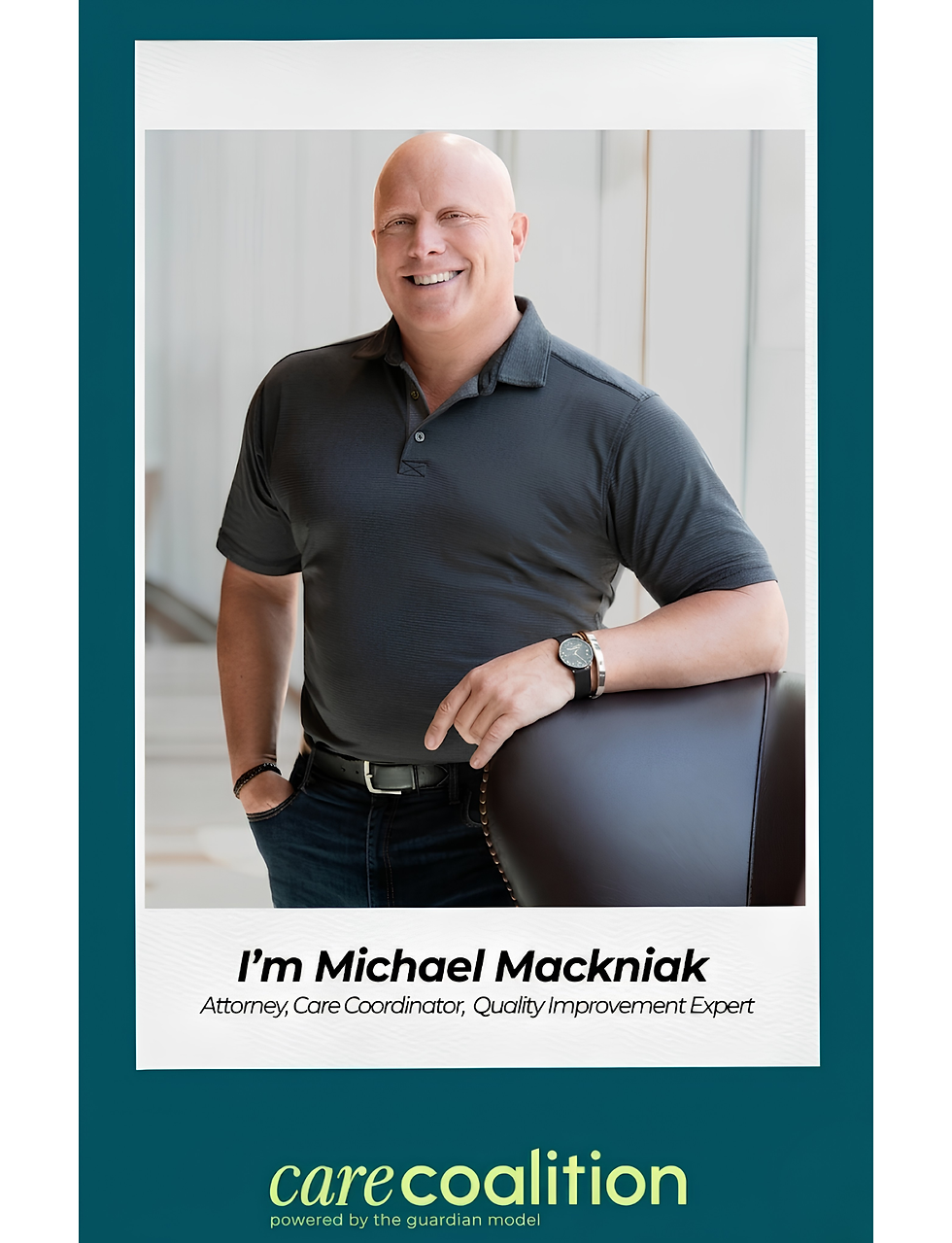
That is where Michael Mackniak steps in. For more than thirty years, he has built his life’s work inside that moment. Not in theory. Not behind policy desks. But in the exact space where systems fail, and real lives begin to unravel.
He is the Founder of Care Coalition. His credentials are extensive, but that is not why families remember his name long after the crisis has passed. They remember Michael because he shows up when everything else falls apart. He does not meet people at their best. He meets them at the moment everything is breaking.
The Work That Happens When No One Else Knows What to Do
A family did everything by the book, but still watched their loved one struggle in an unstable system. When Michael arrived, they felt exhausted and hopeless. Instead of paperwork, he listened attentively, noting their uncertainty and allowing them to share their story uninterrupted.
For the first time, they were not being managed. They were being heard. Michael mapped what was actually happening, not what the system said should be happening. He connected legal authority to real human need. He coordinated care across agencies that had never once spoken to each other.
And for the first time, something shifted. Not overnight, but steadily, intentionally, and in a way that held.
That is the difference between intervention and transformation.

Rebuilding What Was Never Built to Hold People
Early in his career, Michael recognized what many inside the system quietly accept.
The structure itself was the problem.
The system was disjointed and reactive, forcing people in crisis to handle complicated tasks they weren’t prepared for. Families became coordinators, advocates, and caregivers without training or support.
So, he did not try to work around the system. He rebuilt the way it functions.
Through the Guardian Model and Melissa’s Project, he created a coordinated approach that aligns legal structure, mental health care, and real-world application.
This is not conceptual reform. It is an operational change.
The impact is measurable. A seventy percent reduction in incarceration among those served is not just a statistic. It represents thousands of lives redirected from punishment to care. Thousands of families were given back something they thought they had already lost.
Because when systems fail, the cost is not theoretical. It is human.

The Story That Changed the Stakes
In Saving Melissa, Michael shares the real journey of a young woman caught in the revolving door of a system that could not hold her.
It is not written as theory. It is written as reality.
What happens when no one coordinates care? What happens when systems operate in isolation?
What happens when a person becomes invisible inside the structures meant to help them?
Melissa’s story did more than expose the gaps. It forced a solution.
From it came the 7Cs framework, built on consistency, coordination, commitment, communication, collaboration, continuity, and compassion. Not as ideals, but as requirements for outcomes that last.
One of the most overlooked truths in mental health care is not the individual in crisis. It is the people standing beside them.
Parents losing sleep, spouses managing everything, and siblings facing uncertainty at home now benefit from Michael's Care Coalition expansion. Tools like the Care Keeper Journal and Care Compass App help bring stability and clarity. Above all, they remind users that someone cares.
A Leadership Style That Holds
Michael leads quietly, remaining present when others leave, through tough cases, slow progress, and after meetings. His commitment distinguishes him from merely managing systems; it makes his work enduring.
A Different Way Forward
Michael’s work is meant to be shared in the community, supporting caregivers, families, and individuals seeking recognition. The Care Coalition offers more than an additional home health service; it introduces an innovative approach that combines personalized care plans with real-time data tracking.
This approach ensures that each individual's needs are continuously monitored and addressed, making support more responsive and effective.
Because when care is coordinated, when people are seen, and when someone refuses to walk away, outcomes change. Lives change.
And for families who have already felt what it is like to be overlooked, dismissed, and left to figure it out alone, that kind of presence is not just helpful.
It is life-changing.
Connect With Michael
Email: mike@guardian-ct.org


Comments